
“Vibe Coding” Is A Thing Now. And It’s Useful.
The Quick Version:
I tinkered with the idea of vibe coding and ended up with a nifty little table-top app the entire family could use.
I came across the term “vibe coding” one day while scrolling through tech updates and immediately thought: Okay… I’m officially old. What the heck is that?
Turns out, vibe coding is a pretty interesting shift happening in software development right now.
At its core, vibe coding is AI-assisted development where you describe what you want in natural language, and the AI builds the code for you. No deep programming expertise required. You just need the ability to clearly describe an idea.
What Exactly Is Vibe Coding?
Imagine explaining an app idea the same way you’d explain it to a coworker or a developer:
- “Build me an app to track my sleep patterns.”
- “Create a dashboard that tracks tasks.”
- “Make a tool that turns photos into themed art.”
But rather than hiring a developer or asking a coworker to write code line by line, you prompt an AI, refine the idea through normal conversation, and let the system generate the software. In a similar way, this is what I did back when I was building websites for people: simple conversations that turned conceptual thoughts into real results. They communicated an idea, I brought their idea to life.
Vibe coding is less about programming and more about communicating intent.
This shift is important because it lowers the barrier to building software dramatically. If you can clearly describe a problem, you can start creating tools to solve it. That’s a powerful concept for entrepreneurs, operators, and anyone who uses technology to streamline their work (like me).
Enter the Rabbit R1 and Its “Intern”
Not long after learning about vibe coding, something interesting happened with a device I already owned: the Rabbit R1.
I originally bought the R1 as an AI tool to help manage tasks around my farm. Think of it as a pocket-sized assistant that can help retrieve information and interact with services.
Then Rabbit released a major feature called Intern. Before Intern, the R1 could assist you. After Intern, it could act on your behalf. The device evolved from simply storing and retrieving information to building software applications through natural conversation. In other words, it suddenly became the perfect tool for experimenting with vibe coding.
The Unexpected Inspiration: Family Game Night
One night my wife, kids and myself decided to play Cadoo as a family. If you’ve never played it, the game has a timed element. The box comes with a little hourglass timer you flip over to start the countdown. As we were playing, I had a random thought: Could my R1 become a modern-day hourglass timer?
Obviously, the R1 isn’t designed to be a timer. But the device has a unique shape that allows it to stand upright on a table, unlike a phone that has to lay flat.
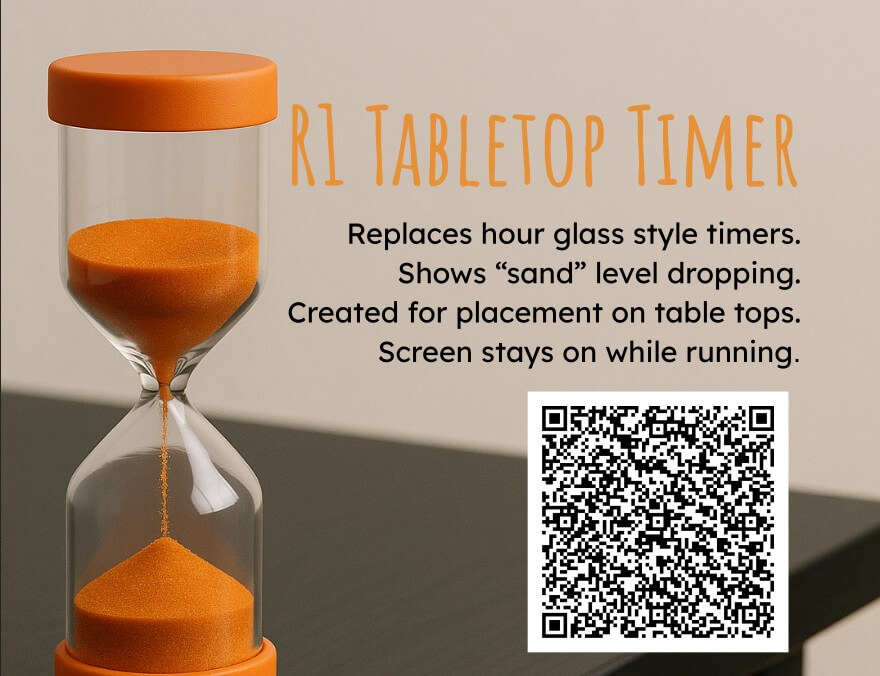
So I tried something simple. I told it, “Create an app that works like a digital sand timer.” After a little back-and-forth conversation about how I wanted it to function and look, viola… it built the app. Within minutes I had a working visual sand timer on my R1. Now I could:
- Set a time
- Watch the sand visually drain on the screen
- And when it ran out… time was up
Simple. But surprisingly useful. In fact, I submitted the app that I created to the creators of the R1 and they decided to add it to their showcase of R1 apps. Now anyone can use it!
Why Visual Timers Are Effective
At first this seemed like a fun experiment, but the more I used it, the more practical it became. Visual timers are powerful because they make time tangible. Instead of abstract numbers counting down, you actually see time disappearing. Like with an hour glass.
This is especially helpful for kids:
- Getting ready for school
- Finishing dinner
- Managing screen time
- Cleaning up toys
Seeing the sand drop teaches the fundamentals of time management – a skill that I’m happy to help them sharpen. But it’s useful for adults too! Even as someone who has spent years managing projects and my own time, having that little sand timer sitting on my desk while I work can be a really helpful tool. It becomes a visual commitment to stay focused until the sand runs out.
No notifications. No distractions. Just the task in front of you.
Why Vibe Coding Matters
This little experiment perfectly captures why vibe coding is so interesting. I didn’t have to open a development environment or install frameworks or libraries. I simply described an idea through conversation until the software existed. That’s a huge shift.
For operators, founders, and problem-solvers, the barrier to building useful tools is collapsing. You don’t need to be a full-time developer anymore — you just need clear thinking and the ability to articulate what you want.
Programming is still a critical skill to know when it comes to certain types of technology, but the most valuable skill may no longer be the coding itself. It may be knowing how to communicate a thought.
Wanna keep reading?